Service Provider Due Diligence Under Reg S-P Compliance
At CyberSecureRIA, our job isn’t to tell advisory firms what to worry about – it’s to help them figure out what risk actually looks like in their real operations. For years, we’ve worked with RIAs and broker-dealers building compliance workflows that don’t just check a legal box, but actually hold up when vendors fail, systems glitch, or the SEC comes knocking.
One of the trickiest parts of modern compliance? Vendors. Platforms, processors, cloud tools… the people you don’t employ but whose servers know everything about your clients.
That’s why service provider due diligence in Reg S-P is now front and center. And why you can’t afford to treat vendor risk as an afterthought – or someone else’s problem.
What Is Service Provider Due Diligence in Reg S-P?
In plain terms, this is the part of Reg S-P vendor due diligence that puts responsibility back on your shoulders – even if the data breach happens on theirs.
If a third-party touches personally identifiable or financial information – whether that’s hosting, processing, ticketing, backing up, or emailing – they count. And so does your lack of involvement, if something goes wrong.
Third-party vendors create messy risks because:
- They aren’t subject to your controls: but clients assume you’re the one keeping their data safe either way.
- You’re relying on what they say, not always what they do: especially if you haven’t tested or reviewed it yourself.
- One vendor, multiple clients: a single failure can spill across dozens of firms, and it’s yours to explain to regulators.
Even advisors who run lean teams and outsource IT are caught here – because outsourced doesn’t mean out of scope.
Why the SEC Emphasizes Vendor Oversight
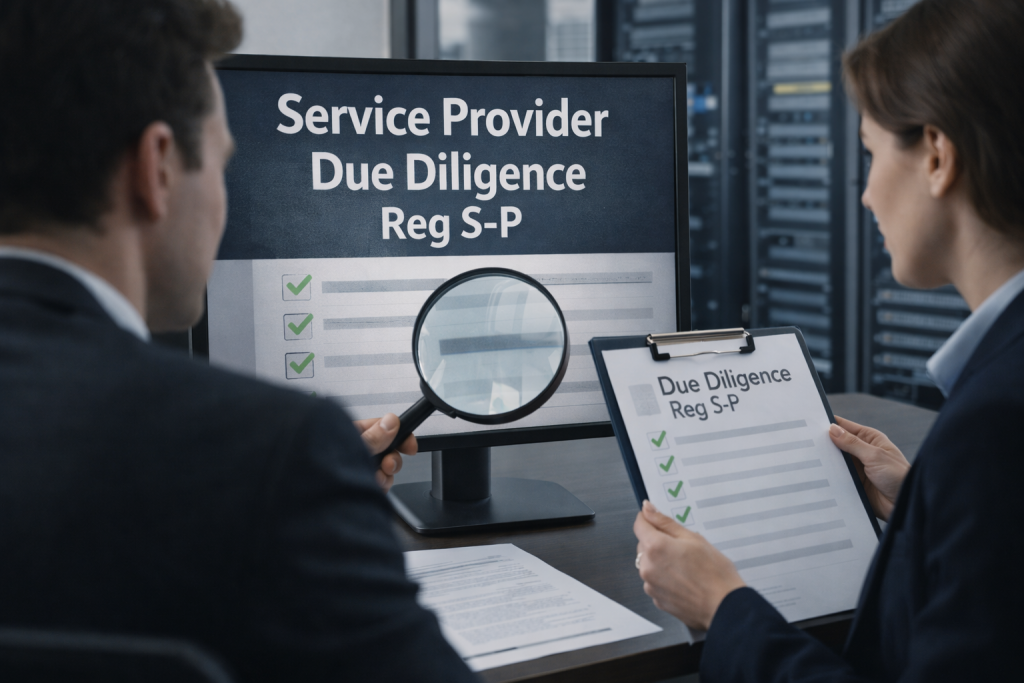
This isn’t just a trend. The SEC has been tightening language around third-party vendor oversight for years, but the tone changed after a pattern of outsourced-service breaches emerged.
We’ve seen the investigation letters. And the theme is consistent:
- “Why didn’t you know sooner?”
- “Where’s the contract?”
- “Who was responsible for follow-up?”
Their stance is simple: if your clients’ data was compromised, and it was a vendor under your roof (even digitally), you are expected to have put controls in place before the breach.
Some driving reasons:
- Leaks don’t always happen internally anymore: breached payroll firms, CRMs, and cloud storage providers canoften drag multiple RIAs into the fallout.
- Delayed notices: many vendors don’t report incidents quickly, and firms don’t learn about exposure until long after the fact.
- Accountability gaps: firms often assumed the vendor had checked all the boxes – but the regulator doesn’t share that assumption.
This is how SEC third party service provider rule concepts are now being tested in real investigations.
Core Due Diligence Requirements Under Reg S-P
So what does compliance look like in practice? Under Reg S-P, broker dealer vendor oversight is no longer a back-office task – it’s a formal obligation with compliance teeth. It’s active involvement – before the contract, during the engagement, and every year after.
Here’s what the SEC now expects:
- Do your homework early: check whether the vendor encrypts data, where it’s hosted, and who has access – ideally before signing.
- Build protections into the contract: not generalities – real language about notifying your firm of a breach, joining investigations, and limiting further exposure.
- Make them part of your incident plan: if the vendor’s systems go down, they need protocols that align with yours – not off-script improvisation.
- Review regularly: vendors shift their models, change infrastructure, get acquired – your due diligence has to keep pace.
New oversight measures under the SEC Rregulation S-P service providers rule don’t just recommend vendor reviews – they compel action backed by contracts, testing, and accountability. The SEC now looks for a working, regulatory due diligence process that produces evidence – not just comfort.
Practical Steps for RIAs to Evaluate Service Providers
You don’t need a dedicated security team to do this well. But you do need structure and a baseline for what’s reasonable to ask.
When assessing vendors, focus on:
- Privacy substance, not fluff: request their security documentation – or at least proof someone internally owns it.
- Technical safeguards: ask basic questions. Is client data encrypted at rest? Who monitors logs? Can someone wipe it remotely if needed?
- Test for disaster: what does recovery look like if their system crashes? Can they restore critical data? What’s the actual downtime?
- Verify privacy rule compliance: make sure they understand what Reg S-P demands, and whether they can provide proof.
- Document the whole process: once reviewed, file the notes. Document what you got back. Firms with records survive audits better.
Evaluation isn’t about perfection – it’s about being able to show regulators how you made safe, informed decisions.
Common Risks When Vendors Fail Compliance
When vendors stumble, they rarely stumble quietly – and the fallout usually hits the firm that hired them first.
You might see:
- Regulatory fines: even when the vendor caused the breach, the firm may be penalized for failure to supervise.
- Client backlash: few things rattle trust more than a letter saying “Your data might be exposed, but it wasn’t our systems.”
- Negative press and reputational damage: the firm – not the obscure cloud provider – takes the headline hit.
- Heightened audit scrutiny: a single vendor incident can trigger a broader sweep through your risk controls and vendor procedures.
Quick story: we worked with a firm that used a data archiving service – seemed safe, widely used. Until it went offline after a ransomware attack and wouldn’t return calls. They had no clause about breach cooperation. They ended up explaining silence to every client and examiner. It won’t happen twice – but it happened once.
How CyberSecureRIA Supports Vendor Oversight Programs
This is our zone. We’ve built entire cybersecurity risk management desks around the idea that third-party risk isn’t temporary.
Here’s what firms rely on us for:
- Real policy frameworks: adapted to your actual vendors, processes, and systems – not generic SOC 2 copy-paste.
- Custom checklists for evaluation: built to match Reg S-P expectations and the ways your firm actually works.
- Collaborative support: our team joins your review process, helps audit documentation, and challenges vendor red flags before you sign.
- Alerts when things change: system integrations that detect vendor updates, breach notices, or failed behaviors inside shared workflows.
Helping you align with financial data protection compliance isn’t about buzzwords – it’s about making sure a vendor issue doesn’t turn into an exam disaster.
Looking Forward: The Future of Third-Party Oversight in Finance
Things are only going to get messier.
Advisors are embracing more integrations, more automation, tighter CRM links, instant reporting platforms, portfolio tools with AI-driven logic. And all of it’s connected – every node becomes part of your compliance battle map.
We expect:
- More proactive exams focused on service providers
- Pressure to document decisions earlier in vendor selection
- Tighter deadlines for breach investigation and notice
- Explicit policies around tech vendors, not just custodians or data processors
You don’t need to panic. But you do need a plan.
If you’re assessing your vendor exposure – or realizing you haven’t looked deeply enough – CyberSecureRIA can help.
We’ll help you build a lean, documented, defensible oversight program that matches how you actually run. Start here →