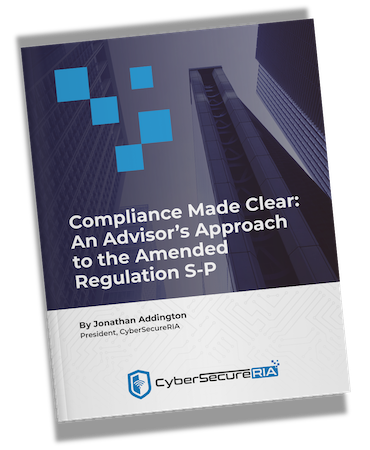
A Registered Investment Advisor’s credibility hinges on two things: the quality of advice given and the confidentiality of client data. Today, investors expect both flawlessly. That’s why CyberSecureRIA exists at the intersection of cybersecurity, compliance, and financial services, offering tailored IT and security programs purpose-built for RIAs. Our clients don’t just “meet” regulatory standards; they operate with systems designed around them from day one.
With more than a decade of experience working solely with RIAs, our team understands not just the tech—but the expectations buried in SEC footnotes, audit prep forums, and evolving digital risk landscapes. We know the Regulation. We speak RIA. And we deliver peace of mind at a time when digital exposure is more costly than ever.
What Is RIA Regulation S-P?
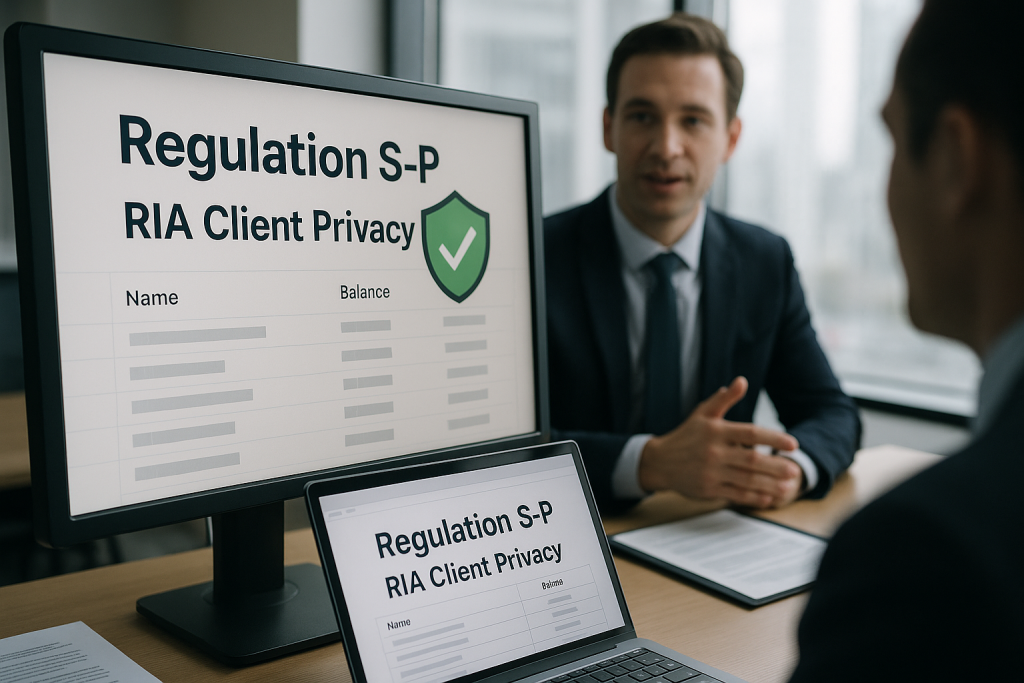
RIA Regulation S-P refers to the application of the SEC’s Regulation S-P privacy rule to Registered Investment Advisors, placing clear obligations on how firms handle, store, and share nonpublic personal information (NPI) of their clients.
Created under the Gramm-Leach-Bliley Act (GLBA), the rule serves one critical purpose: To preserve client confidentiality in finance by standardizing baseline protections across financial services firms, including broker-dealers and investment companies.
Among RIAs, this rule isn’t just regulatory—it’s reputational. If you want clients to place trust in your investment strategies, you must first prove you’ll treat their financial information with equal care.
Why Regulation S-P Matters for RIAs
Regulation S-P has teeth. It’s enforceable. It’s specific. And it’s not hard to violate unintentionally.
Failing to comply may result in:
- SEC investigations and enforcement actions
- Reputational damage and client attrition
- Financial penalties or loss of registration
But beyond legal risk, the rule highlights the very thing clients worry most about—not just where their money goes, but who might be able to access that information.
Unlike large brokerages with internal infrastructure, RIAs often face disproportionate risks:
- Limited in-house IT personnel
- Reliance on external vendors with varying security standards
- Less formalized staff training or change control processes
Regulation S-P levels the field… and exposes the cracks.
Core Requirements Under RIA Regulation S-P
The RIA compliance requirements under Regulation S-P fall into four critical categories:
- Privacy Notices: Advisors must provide these at the start of the client relationship and annually thereafter, explaining data collection, storage, and sharing practices.
- Regulation S-P Disclosure Rules: RIAs must clarify when and why they share client information and provide opt-out opportunities for certain cases.
- Safeguards Rule: This requires a written, tested, and evolving plan to protect client data using technical, physical, and procedural security measures.
- Third-Party Risk Oversight: RIAs can’t outsource compliance. You’re responsible for vendors who access or interact with client data.
These requirements form the core of what’s expected under a financial privacy program designed to weather both audit scrutiny and real-world threats.
The Safeguards Rule Explained
The Safeguards Rule under Regulation S-P goes beyond general policy. It requires detailed controls tailored to the firm’s systems and personnel.
RIAs must demonstrate:
- Administrative safeguards – defined roles, training programs, and escalation procedures
- Technical safeguards – encryption, secure communications, and access control
- Physical safeguards – restricted access to hardware, secure document disposal, badge access, etc.
Examples of practical steps include:
- Enabling MFA across all cloud tools
- Separating admin rights from daily-use accounts
- Logging vendor access and reviewing it quarterly
- Storing client statements in encrypted repositories with monitored access
If these controls are not documented, tested, and updated, they don’t count.
Privacy Notices and Client Communication
RIA privacy notice requirements are often under-emphasized—but they carry legal weight, not just informative function.
Every RIA must:
- Deliver a privacy notice at the start of every client relationship
- Reissue that notice every twelve months
- Update the notice any time data practices or sharing partners change
- Clearly identify client opt-out rights concerning non-affiliated third-party data sharing
A well-constructed privacy notice improves client understanding and trust, minimizes resistance to onboarding, and demonstrates accountability before the SEC even asks.
Recent Amendments and SEC Enforcement Trends
The SEC has recently proposed or implemented amendments that significantly raise expectations for RIA cybersecurity. Among the most critical are:
- Mandatory data breach response protocols that include client notification deadlines
- Stricter expectations around risk assessments and reporting
- Increased audits focused specifically on internal controls and third-party oversight
Recent SEC enforcement actions signal a clear shift: not having a policy, or failing to follow one written years ago, is grounds for penalty—regardless of actual breach occurrence.
That’s why CyberSecureRIA isn’t just focused on protection—we’re war-gamed for the readiness your next audit will demand.
Challenges RIAs Face in Implementing Regulation S-P
Compliance isn’t just about knowledge—it’s about execution. And RIAs face very real, very practical obstacles:
Vendor risk management – cloud systems, CRMs, billing tools—do you know who handles your data, and how?
Outdated IT infrastructure – legacy systems without encryption or remote access control
Lack of employee awareness – frontline staff who introduce risks via poor password practices or unsecure devices
CyberSecureRIA routinely helps RIAs navigate these issues by aligning technology, training, and policy—removing complexity from the equation and replacing it with control.
Best Practices for RIA Compliance
To truly comply with the Regulation S-P privacy rule, RIAs should embed protection into every layer of their operation.
Here’s what that looks like:
- Encrypt all NPI in storage and transmission
- Define and rehearse a data breach response plan
- Conduct outside security audits quarterly or biannually
- Implement routine training with testing for phishing, ransomware, and access policies
- Limit and monitor third-party vendor access to sensitive systems
RIA compliance requirements can’t afford to remain on paper—they must be visible in behavior, infrastructure, and culture.
How Technology Supports Regulation S-P Compliance
Technology isn’t a barrier—it’s your best partner. The right setup allows RIAs to meet Regulation S-P standards while increasing operational efficiency.
CyberSecureRIA deploys:
- Endpoint detection and response (EDR) software with automated alerting
- Cloud-first infrastructure with data encryption, access control, and internal segmentation
- Compliance dashboards with audit logs, user access patterns, and documentation tools
- Apple-native security features and cloud sync for RIAs working in macOS workspaces
When systems are aligned with compliance by design, you don’t have to scramble to meet new rules—they’re already in motion.
CyberSecureRIA’s Role in RIA Compliance Support
CyberSecureRIA bridges the exact gap RIAs face: legacy tools and growing regulatory expectations. We are not a generic IT vendor. We are compliance architects with deep experience in the regulatory language, workflows, and risk appetite of the financial advisory space.
We help RIAs:
- Build SEC-aligned cyber policies from the ground up
- Create, test, and document full breach response plans
- Implement frictionless, cloud-secure systems
- Train entire firms—from partners to assistants—in how to preserve client data trust
- Stay perpetually prepared for next-year audits—not rush into disaster response
If your privacy plan lives in a Word doc and hasn’t been tested this year, it’s probably not a plan.
Let’s turn that into a framework you can stand behind, in front of both clients and regulators. Learn how CyberSecureRIA builds confidence through compliance!