AI Phishing and Deepfake Threats: A Playbook for Modern Firms
If you think you’re ready for the next generation of cyberattacks, you probably aren’t. AI isn’t coming for your infrastructure – it’s coming for your employees’ assumptions, judgment, and reflexes. And most firms don’t realize until it’s too late.
This playbook cuts through the fog. Here’s what AI phishing and deepfake threats actually look like, how they bypass current defenses, and how you can build new ones before someone tests the limits of your response plan.
What Are AI Phishing and Deepfake Threats?
Forget the grainy stock photos and broken grammar of a classic phishing email. In 2025, attackers are using commercial-grade generative AI email attacks – powered by large language models – to craft flawless, tailored messages that look like they came from your COO or a VIP client.
Meanwhile, synthetic media fraud – known as deepfakes – has evolved from novelty to weapon. With a short voice sample, someone can now mimic your managing partner on the phone. With a few LinkedIn photos, they can drop your CEO into a video call asking to release funds or reset account credentials.
These aren’t future threats – they’re already in the field. What’s new here isn’t the idea of deception. It’s the precision, realism, and speed AI-driven social engineering brings to the table.
How Generative AI Supercharges Classic Phishing Attacks
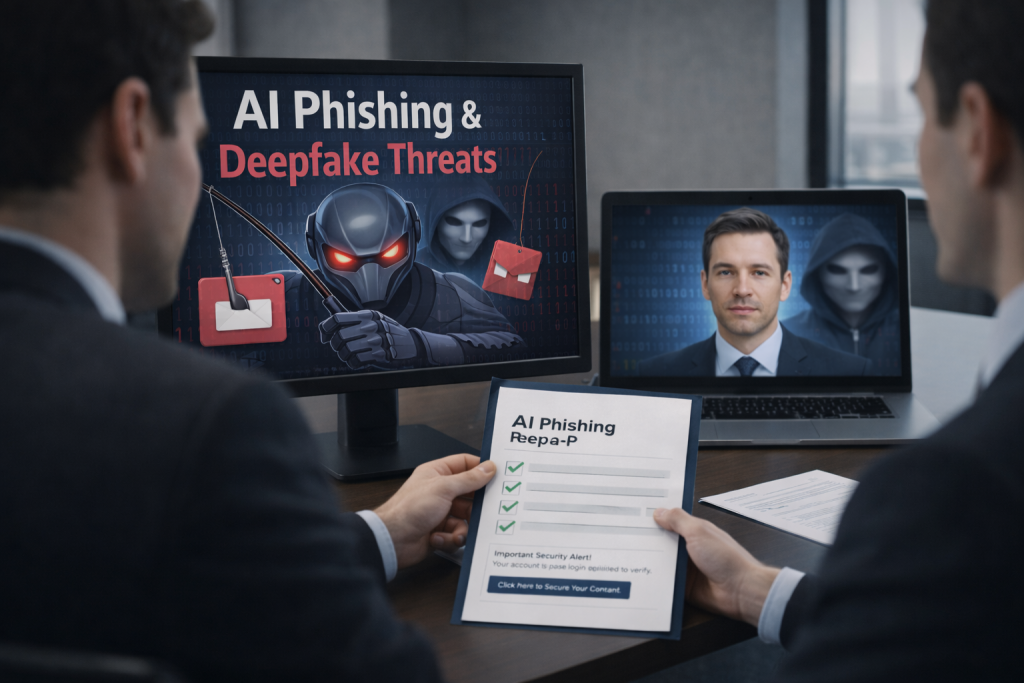
Before, phishing relied on sloppiness. Misspelled names. Gmail return addresses. Desperate language. You trained your team to spot the flaws and move on.
Now? The game’s flipped. AI-powered phishing attacks scrape data from your website, vendor pages, LinkedIn bios, even CRM exposures to create tailored attack profiles at scale. Language is clean. Context is perfect. Urgency feels justified. Names are real.
Tactics used:
- Recent announcements: attackers reference real hires, product updates, or office moves
- Personalized signals: they mimic tone and timing based on your team’s actual communication habits
- Layered approach: phishing isn’t just email anymore – it’s followed up with texts or calls to create urgency
Result: your email filter sees nothing suspicious. Your team sees a smart, relevant message. And the only thing that saved you yesterday won’t work tomorrow.
Deepfake Voice and Video: From CEO Fraud to Fake Client Calls
One of our clients thought they’d never fall for CEO fraud. “We always verify,” they said. Until a junior ops staffer got a video call from the managing partner. Same face. Same voice. Same headset. The partner asked for a one-time wire override. The staffer complied.
It wasn’t real.
That’s the moment deepfake voice impersonation and face-swap video crossed into the advisory world. And now that it’s here, basic “I saw them speak” is no longer strong evidence.
What attackers are exploiting:
- Executive urgency: deepfake “CEO” calls create pressure to move quickly
- Client familiarity: convincing video or voice messages trigger automatic trust
- Layered fraud: a fake video + a confirming email feels ironclad – until it isn’t
These kinds of deepfake phishing scams don’t need to be perfect – they just need to feel urgent, credible, and hard to double-check in the moment.
Why AI Phishing and Deepfake Threats Bypass Traditional Controls
Old defenses fail for one brutal reason: they weren’t designed for realism.
Today’s filters still look for suspicious senders, uncommon phrases, and weird formatting. But AI-generated phishing emails are indistinguishable from internal correspondence. Voice-based verification fails when the fraudster sounds like your CFO. MFA barely helps if the attacker’s pretending to be a client and already has access.
Where gaps appear:
- Email filters: trained for spam, not realism
- Verification scripts: written for phone banks, not synthetic callers
- MFA prompts: usually accept any device, even if the context is clearly off
- “Got a weird message?” training: assumes messages seem weird – they won’t
Worse: multi-channel impersonation attacks mix mediums – email, phone, video, chat – to create a total illusion. That makes single-point controls functionally useless.
Real-World Scenarios: AI Phishing and Deepfake Threats in Financial Services
Based on situations we’ve handled firsthand – and out of respect for our clients’ confidentiality – we’ve reimagined a few illustrative examples. None of these are pulled from a file, but all of them are built on patterns seen in the wild.
Picture this: a portfolio manager receives a casual email from a long-standing client. The message feels familiar, informed – even routine. Hours later, the same client calls. They never sent it.
Or: someone in operations gets a call from their CIO. The voice is unmistakable – or so it seems. He’s locked out, needs access restored fast. There’s urgency in his tone, pressure in the moment. But the real CIO is still logged in, across the hall.
And in another case, a “custodian support rep” chats in with a sync issue. They know the platform. The name checks out. The assistant walks them through basic verifications – just trying to help. No one realizes until much later: the rep was synthetic, and the entry point had been rehearsed.
In each case, nothing looked fake. That’s exactly what made it dangerous.
Building Defenses Against AI Phishing and Deepfake Threats
The key shift? Assume every message is well-crafted and every voice sounds right – and defend from there.
Email protections:
- Behavioral detection: flag login pattern shifts and strange sending behavior
- DMARC enforcement: stop spoofing at the domain level
- Anomaly alerts: monitor tone, style, and sender fingerprints
Identity verification protocols:
- Shared secrets: internal-only phrases not found in documentation
- Callback process: never approve by phone without calling back over a known number
- Out-of-band authentication: requires secure second channels for approvals
Technical strategies:
- Device + location monitoring: block access from unrecognized logins
- Behavior-based AI alerts: look for policy-breaking behavior, not words
- Layered approvals: sensitive changes require personnel separation and review logs
Technology alone won’t save you – but the right controls will slow an attacker before they reach decision points.
Training People to Spot AI-Driven Social Engineering
Let’s be honest: nobody on your team cares about another “don’t click weird links” PowerPoint. But AI social engineering attacks require a new kind of user education – closer to roleplay than rules.
What works now:
- Examples: real (and fake) messages, deepfake clips, and decision-points
- Audience segmentation: front office, advisors, CSAs, and leadership all get different versions
- Modern verification scripts: staff should have approved language for pushback (“I need to call you back on your onboarded line…”)
- Simulation drills: test your team with AI-generated emails and voice messages
Most importantly? Create a pause-and-verify culture. Staff need both permission and confidence to slow things down – especially when the message feels urgent and looks perfect.
Roadmap: Reducing AI Phishing and Deepfake Risk in the Next 12 Months
Executives don’t need a ten-year plan. They need a one-year playbook. Here’s what that looks like:
Immediately:
- Incident response updates: include AI/deepfake threat paths
- Risk register: add synthetic impersonation and LLM-driven phishing
- Approvals: tighten authority layers for high-value or time-sensitive requests
Next 6 months:
- Secure messaging overhaul: ditch unverified systems for pre-approved, protected channels
- Email filtering upgrade: enable LLM-aware detection tools
- Vendor vetting: confirm your third-party tools can’t be reverse-spoofed
Ongoing:
- Annual AI threat simulations
- Quarterly training refresh
- Quarterly policy reviews for human verification
- Continual threat modeling updates based on evolving attack types
Modern fraud isn’t cheap, lazy, or clumsy anymore. So your defenses can’t be either.