At CyberSecureRIA, we understand that Registered Investment Advisers (RIAs) live under constant pressure—from regulators, from clients, and increasingly, from cyber threats. For years we’ve specialized in supporting RIAs with cybersecurity, managed IT, and SEC compliance solutions built for the reality of your business. Unlike general IT vendors, we don’t retrofit our services to financial firms—we design everything for RIAs from the ground up.
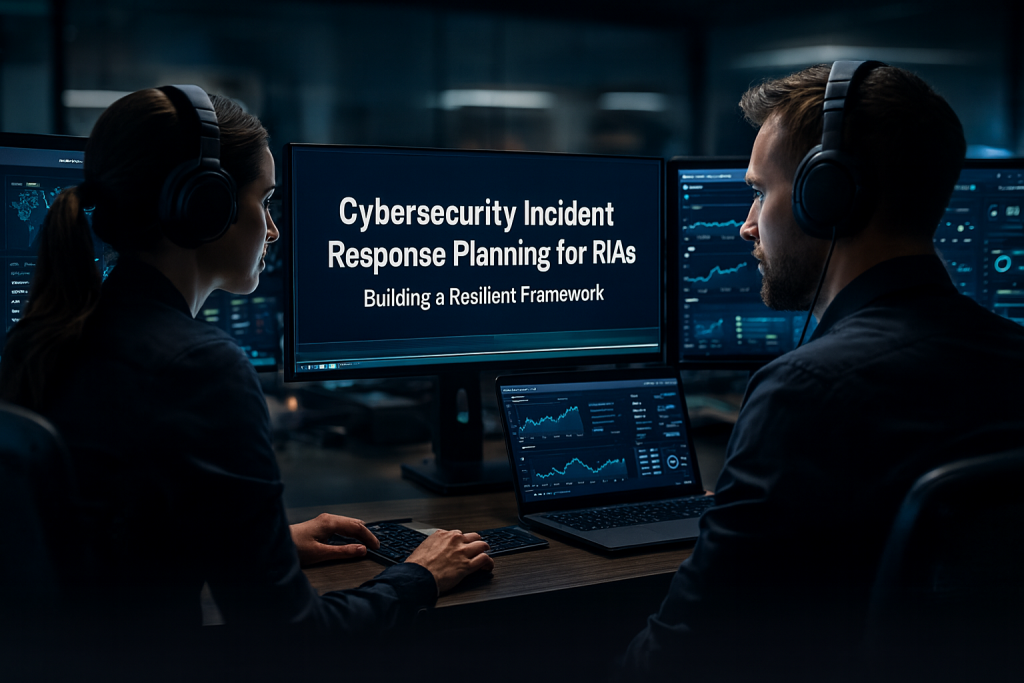
Compliance, availability, and trust sit at the heart of what you deliver. When a cybersecurity event hits, those values are tested instantly. That’s why cybersecurity incident response planning for RIAs is no longer a technical suggestion—it’s a central obligation under federal regulation.
Understanding the Importance of Incident Response Planning for RIAs
RIAs handle incredibly sensitive data—account numbers, statements, tax IDs—and most operate with lean teams and cloud-first systems. That combination makes your firm a high-value, soft target for cybercriminals. And when something goes wrong, the response has to be immediate, coordinated, and well-documented.
What’s changed in recent years is that incident response isn’t just about protecting operations. Under Regulation S-P, RIAs are required to maintain documented procedures for detecting, containing, and recovering from incidents involving unauthorized access to client information. In other words, your incident response strategy for investment advisors must exist on paper and in practice.
Without a tested, written plan, a data breach becomes more than a crisis—it becomes a compliance problem. That’s why today, more than ever, incident response planning for RIAs is not optional at all.
Key Components of an Effective Incident Response Plan
A plan that works in real life reads more like a playbook than a policy. When something looks off, the first job is to stop the blast radius: suspend risky accounts, kill active sessions, quarantine affected devices, revoke tokens, and lock down external sharing. Only then do we go after the root cause—malware, malicious mailbox rules, rogue cloud authorizations, persistence mechanisms—so the problem doesn’t quietly grow back overnight.
Recovery isn’t a big-bang switch-on. We restore from known-good backups, rotate credentials, re-enroll MFA, and bring systems online in stages, validating data and access as we go. And when the smoke clears, we write the story down: what happened, who decided what, when actions occurred, what changed, and what we’ll do differently next time. That record becomes training material, audit defense, and the basis for tightening controls. This is the practical backbone we use when developing incident response plans for RIAs—built to be followed at speed, not admired on a shelf.
Regulatory Requirements and Compliance Considerations
The SEC’s view has hardened. Under the amended Regulation S-P, exam teams expect to see a living, dated playbook; proof your staff knows it; and a complete incident file for any material event—timestamps, affected systems and data, the decisions you made and why, who was notified and when. If you decide an event doesn’t rise to a breach, they’ll want the rationale. In short, Compliance with SEC incident response regulations is now proven with artifacts, not promises.
Our approach aligns the policy with the paperwork: an operational IRP tailored to your environment, an incident log template that captures the facts as they happen, decision trees that map to your escalation thresholds. That way, your incident response strategy for investment advisors reads the same on paper as it looks in practice—credible, timely, and defensible.
Developing a Tailored Incident Response Strategy
Templates don’t cut it. Every RIA operates differently—your tools, vendors, staffing, and client communications all shape how you’ll react under stress. That’s why we focus on developing incident response plans for RIAs that reflect real operations: Who manages devices? Where does sensitive data live? Who communicates with clients? Are advisors in-office, hybrid, or remote?
We design IRPs to match your custodians, your risk appetite, and your day-to-day workflows. When it matters most, the best plan is the one your team already knows how to follow.
Roles and Responsibilities Within the Incident Response Team
A plan works when everyone knows their job. We clarify who leads, who documents, who fixes, and who communicates—so there are no gaps in the heat of a crisis. Typical designations include:
- Incident Coordinator – Leads the response effort and makes time-sensitive decisions.
- Compliance Officer – Oversees documentation, recordkeeping, and disclosure steps.
- IT/MSP Partner – Handles containment, recovery, and technical validation.
- Executive Contact – Authorizes client/vendor communications and continuity actions.
We also provide simple call trees and flowcharts so teams can move quickly and keep records clean.
Integrating Incident Response Planning with Business Continuity
Your response can’t exist in isolation. If systems go down, how do clients reach you? What’s the fallback for secure communications? What happens to billing, reporting, and trading workflows? That’s why we pair incident response with business continuity planning for RIAs. Recovery points, secure access pathways, and operational priorities tie directly into your IRP—so cybersecurity doesn’t turn into operational chaos. Designed together, both plans reinforce each other and create a resilient framework.
Training and Awareness for Effective Incident Response
The best-written policy fails if your people don’t know it—or don’t know how to act when it counts. We run focused training that prepares staff to recognize threats and follow the plan calmly and consistently. Think realistic scenarios: a convincing wire request, a misdirected report with client data, a lost device with live credentials. Repetition builds clarity. Clarity builds confidence.
Leveraging Technology for Incident Detection and Response
Many RIAs already have solid tools—endpoint protection, email filtering, encryption, backups—but too few connect those tools to specific response actions. Rather than piling on new software, we align your current stack with your IRP so the right alert reaches the right person with clear, pre-approved steps. The goal isn’t noise. It’s signal—plus documentation that proves what happened and when.
Evaluating and Updating the Incident Response Plan Regularly
Plans age. Teams change. Regulations evolve. That’s why we treat your IRP as a living control. We recommend formal reviews every 6 to 12 months, with updates after technology changes or significant events. Post-incident lessons learned should feed directly back into the plan. A living plan is reliable—and auditable.
Partnering with Cybersecurity Experts for Incident Response Planning
Building your response plan internally might sound efficient—until it’s not. At CyberSecureRIA, we’ve supported RIAs through real crises, mock exams, and response tests. We understand how regulation, security, operations, and communication intersect, and we don’t guess when client data is at risk. Whether you’re starting from scratch or elevating a policy that’s outlived your firm’s growth, we’ll help you build it right the first time. Ready to create or refine your RIA’s cybersecurity response strategy? We’ll help you build a response plan that’s thorough, testable, and fully aligned with Regulation S-P. Visit https://www.cybersecureria.com/sec-compliance/ and schedule a consult today.